


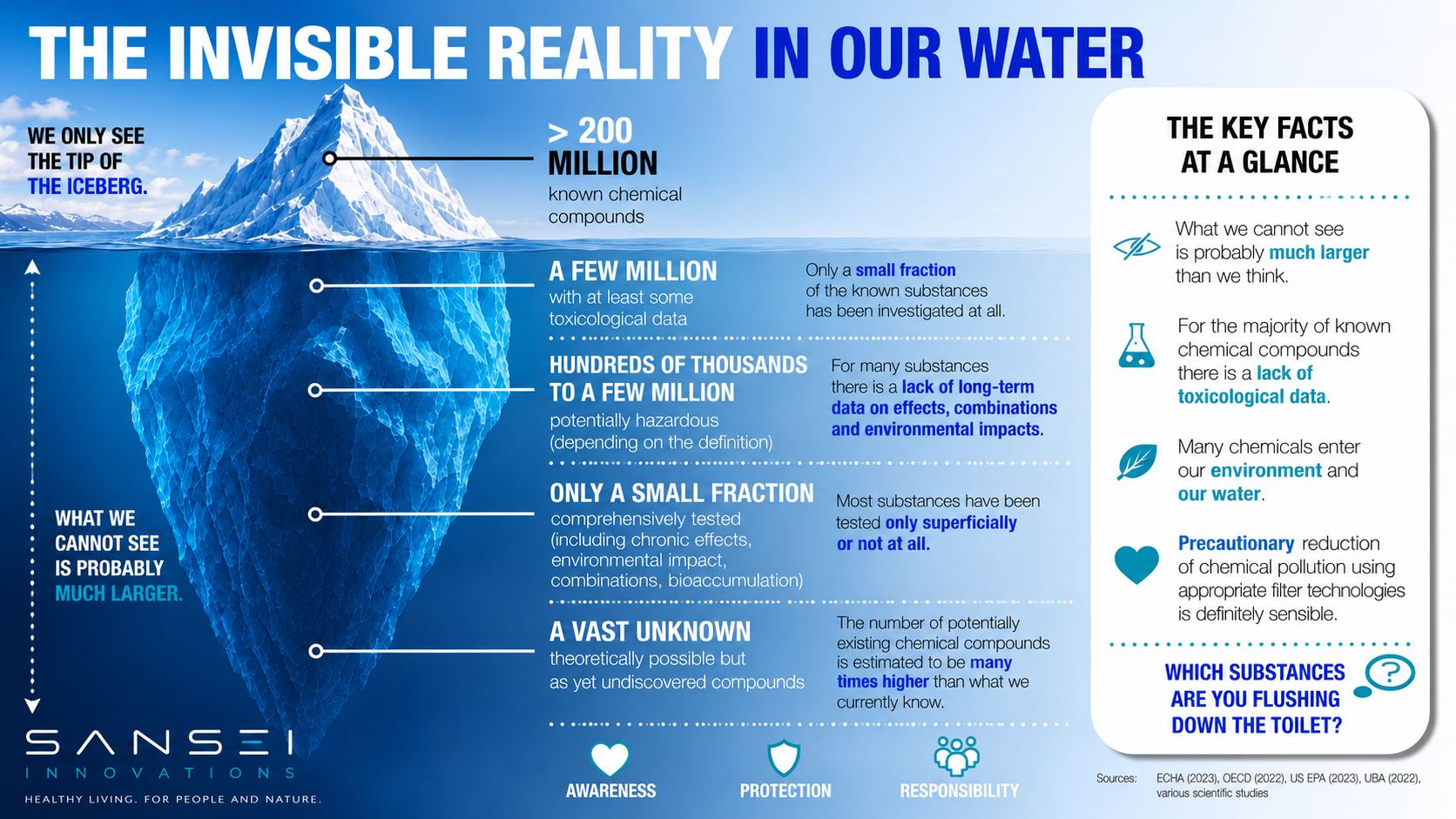
Finding a chemical in water is not the same as finding a health risk. That distinction matters. The CAS REGISTRY now contains more than 200 million registered substances, but this figure does not mean that all of them are used industrially or occur in water. It is, above all, a measure of chemistry’s extraordinary variety.
For many substances, evidence about their properties, environmental behaviour and possible health effects remains limited. Drinking-water standards, meanwhile, exist for only some of the substances known to science. That is not evidence that drinking water is generally dangerous. It does show that monitoring and assessment focus on particular substances, groups of substances and identified risks.
The sensible starting point is therefore to separate four things: an analytical finding, actual contamination, meaningful exposure and a demonstrated effect.
What water testing can — and cannot — tell you
More than 200 million registered substances
Chemical databases contain more than 200 million registered substances, including organic and inorganic compounds, salts, metals, polymers, natural substances, biological molecules and substances with variable compositions.
That number should not be read as a count of the chemicals in water. Many registered substances are produced only in small quantities, used solely in closed industrial processes or no longer used at all. Others arise later as degradation products, by-products or combustion residues.
Why drinking-water limits apply to only some substances
A drinking-water limit is not created simply because a chemical has been identified. Setting one requires information about toxicity, human uptake, long-term exposure, occurrence in water and the ability to measure the substance reliably.
Resources for toxicological research and monitoring are finite. Authorities and specialist bodies therefore concentrate on substances that are widespread, particularly persistent or mobile, or for which health or environmental effects are plausible or already established.
For many chemicals, the evidence is incomplete. An absence of research is neither proof of safety nor proof of a health hazard.
Measurement, limit and risk are different things
- Measurement: a substance has been detected using a particular method and above its limit of quantification.
- Limit: a legally or technically defined concentration that must not be exceeded, or that serves as a benchmark for assessment.
- Exposure: people or animals actually take up a substance, for example through drinking water, food or air.
- Risk: the relevant factors include the substance’s properties, its concentration, the duration and route of exposure, and the sensitivity of the people affected.
A finding in a river does not automatically mean that the drinking water supplied to you is unsafe. Equally, a low concentration is not necessarily irrelevant. The substance and the circumstances determine how the result should be understood.
How chemicals reach the water cycle
Chemicals can enter water through a range of routes:
- agriculture, particularly plant-protection products, fertilisers and veterinary medicines
- urban areas, household chemicals, cleaning products and personal-care products
- medicines from households, hospitals and veterinary practice
- industry and commerce, including solvents, process chemicals and auxiliary substances
- transport, for example tyre wear, fuels and corrosion protection
- landfill sites, contaminated land, firefighting foams and other polluted locations
- degradation products formed when original substances break down
Some substances reach streams and rivers through treated wastewater. Modern treatment plants remove many contaminants, but they do not completely retain every micropollutant. In Switzerland, selected wastewater treatment plants are therefore being equipped with additional treatment stages.
Other substances seep directly into the ground or are washed away by rain. Persistent, mobile compounds are of particular concern. Examples include certain pesticide metabolites, PFAS, chlorinated solvents and other industrial chemicals.
Natural processes can alter substances, too. An original active ingredient may produce several degradation products, each with different properties. Some may be more mobile or persistent than the original substance.
Why Switzerland’s water resources need careful protection
Groundwater supplies most drinking water
Groundwater and spring water provide well over 80 per cent of Switzerland’s drinking-water supply. Protecting the subsurface is therefore especially important. Groundwater is invisible, and its movement varies according to the geology, rainfall and local conditions.
Many productive aquifers lie in river valleys and across the Swiss Plateau. These are also areas with substantial settlement, transport, industrial and agricultural activity. Some of the country’s most important drinking-water resources are consequently located where numerous substances are used and transported.
Micropollutants in surface waters
Numerous micropollutants are detected in Swiss rivers and streams, including pesticides, medicines and other chemicals. Depending on the substance and the water body, concentrations range from nanograms per litre to micrograms per litre.
Pesticides are often particularly relevant in small and medium-sized streams. Larger rivers may contain medicines among other substances. For aquatic organisms, individual chemicals can be problematic even at very low concentrations.
These findings initially describe a stream or other surface water. They are not automatically a measure of the quality of the drinking water supplied to you. Between a polluted stream, a groundwater abstraction point and your tap may lie dilution, natural retention, treatment and monitoring — depending on the circumstances.
Standards cannot cover every conceivable substance
Switzerland has legal requirements for numerous chemical parameters in drinking water and water protection. Maximum values apply to selected PFAS, for example, while pesticides and certain medicines are also covered by water-protection legislation.
There is nevertheless no limit for every known chemical. When new substances or groups of substances emerge, measurement methods, toxicological assessments and legal requirements may still need to be developed. Monitoring must therefore evolve continuously.
Assessing health and environmental effects
Health risks depend on exposure
Whether a chemical can affect your health depends not simply on its existence or detection. Important factors include:
- the concentration and duration of exposure
- uptake through drinking water, food, air or the skin
- the substance’s toxicity and mode of action
- the sensitivity of children, pregnant people, older people or people who are ill
- simultaneous exposure to several substances
For some chemicals, effects on organs, the hormone system, reproduction or genetic material are well studied. For others, the evidence is patchy. Mixtures are particularly difficult to assess because people and ecosystems are rarely exposed to just one substance at a time.
A missing limit therefore cannot be taken as proof that a substance is safe. Nor is it sound to treat every detection as an immediate threat without considering the concentration.
Ecological effects follow different criteria
Aquatic organisms can be more sensitive to certain substances than people are. Pesticides and some medicines, for instance, may harm fish, invertebrates or algae at very low concentrations.
Environmental assessments therefore use different criteria from those applied to drinking water. A concentration may matter to a sensitive aquatic species without representing an immediate health risk to people.
What “only a small fraction has been tested” really means
There is no single, precisely calculated worldwide percentage of chemicals that have been fully assessed for health effects. It is unclear which substances should count as “in use”, “tested” or “adequately assessed”. Databases and legal requirements also vary between countries and according to how a substance is used.
What is clear is that a large number of known or used chemicals have not been comprehensively assessed for every relevant health and environmental risk. The statement is therefore useful as a warning about a substantial knowledge gap — not as a precise statistical percentage.
What can be done
Prevent pollution at source
The most effective approach is to stop problematic substances entering the environment in the first place. That means targeted rules for chemicals of particular concern, careful use of plant-protection products and the development of safer alternatives.
Industry, commerce, agriculture, local authorities and households all have a part to play. Use products at the recommended dose, and never dispose of them down the toilet, sink or road drains.
Continue improving wastewater treatment
Additional treatment stages can substantially reduce some micropollutants. They do not, however, replace prevention at source. Technical removal can be resource-intensive and may transfer substances into other waste streams.
A durable solution therefore combines prevention, cleaner production, appropriate wastewater treatment and risk-based monitoring.
Strengthen monitoring and assessment
Authorities and specialist bodies should update monitoring programmes as new evidence emerges. Priorities include more sensitive analysis, investigation of degradation products, a better understanding of mixtures and improved data sharing between researchers, industry and public authorities.
Clear communication matters to you, too. It should distinguish plainly between environmental contamination, drinking-water quality and health risk.
What you can do at home
- Never dispose of medicines down the toilet or sink; return them to an appropriate collection point.
- Use cleaning and gardening products sparingly and according to the instructions.
- Do not pour chemicals, paint or solvents into road drains or the sewage system.
- If you use a domestic water filter, make sure there is a specific reason for doing so, maintain it correctly and replace the filter regularly.
- Ask your local authority or water supplier for information about local drinking-water quality.
A household filter is not automatically necessary. It may be useful where a local contaminant has been identified, but it must be suitable for that particular substance. Poorly maintained equipment can even reduce water quality.
The next phase of water protection
The number of known chemical substances will continue to grow. At the same time, analytical techniques, databases and models for assessing substance properties are improving. Compounds and degradation products that currently escape detection may become easier to identify.
Assessment is also moving beyond individual chemicals towards groups of substances. PFAS illustrate why: many of these compounds share similar properties and need to be considered together. Mixture effects and persistent degradation products are receiving greater attention as well.
The future of water protection will not be secured simply by measuring ever smaller concentrations. It will depend on sound precaution, reliable data, effective controls at source and treatment tailored to the contamination actually present.
For Switzerland, the task is clear: protecting groundwater and surface water remains essential. Existing controls and legal requirements provide an important foundation, but they must keep pace with new substances, new evidence and changing environmental conditions.
The central conclusion is reassuring, but not complacent: the sheer number of known chemicals is no reason for blanket alarm. It is, however, a strong argument for precaution, transparent monitoring and determined protection of the water resources on which you depend.
Sources and further information
- Federal Office for the Environment (FOEN) — Naqua PFAS
- Federal Office for the Environment (FOEN) — PFAS ChemRRV
- Agroscope — Yxrpb25Jzd02Njawmq==
- World Health Organization (WHO) — Guidelines for Drinking-water Quality: frequently asked questions
- World Health Organization (WHO) — 9789240045064
- Federal Food Safety and Veterinary Office (FSVO) — PFAS
