


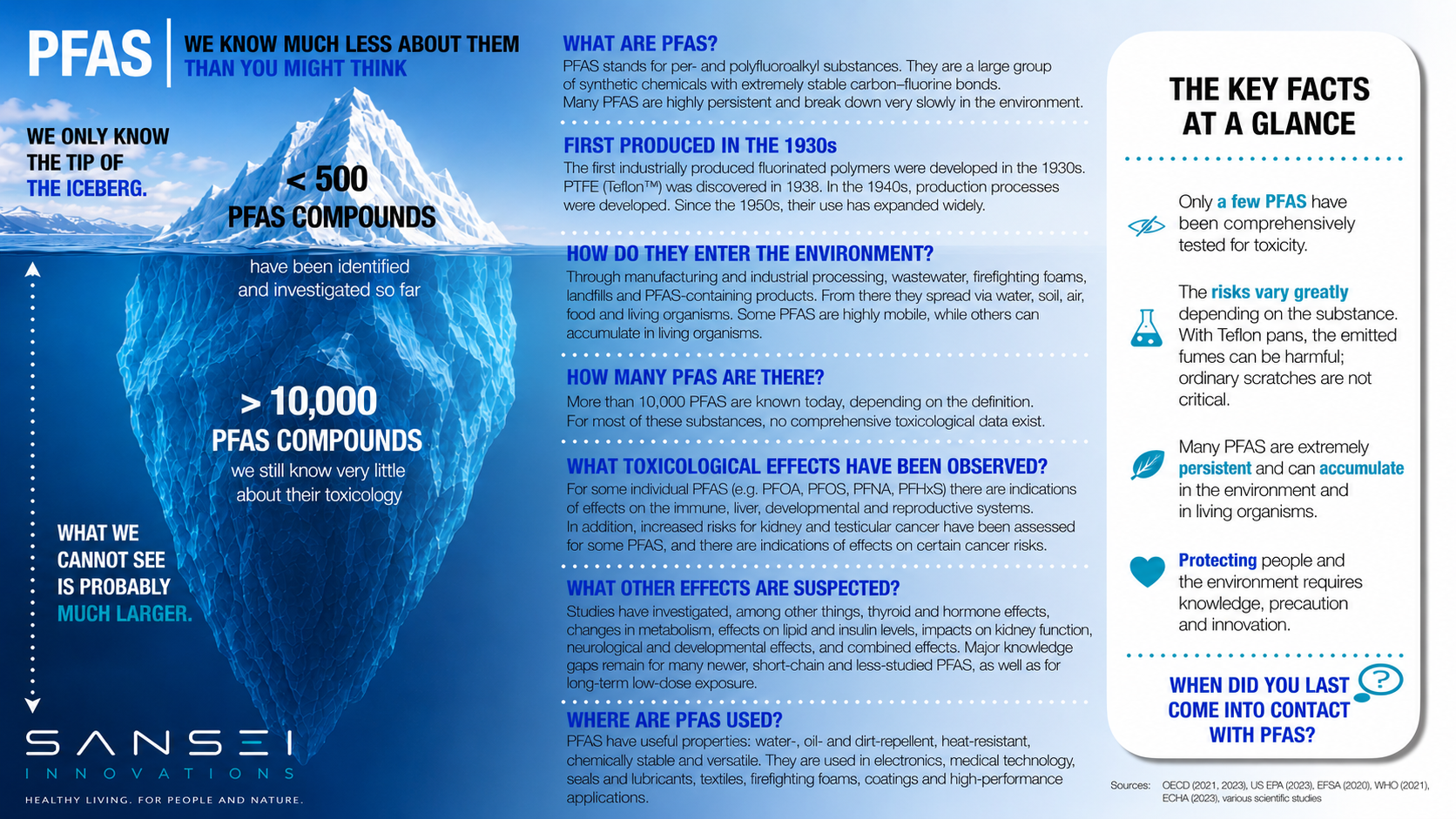
When a chemical is detected in groundwater, the natural reaction is to wonder whether it is coming out of your tap. With PFAS, that conclusion is rarely as straightforward as it sounds. Groundwater is not necessarily the same water that reaches your home, and finding a substance in a sample is not, by itself, a diagnosis of harm.
The wider picture is complicated by the fact that PFAS are not one chemical but a large family of substances. Some accumulate in living organisms; others travel readily through water. Many persist in the environment for years. A single measurement—and certainly a blanket promise that a filter ‘removes PFAS’—cannot tell the whole story.
The chemistry that made PFAS so useful
PFAS is short for per- and polyfluoroalkyl substances. This group of synthetic organofluorine compounds includes PFOS, PFOA, PFHxS and PFNA. Their resistance to water, oil and dirt, together with their chemical and thermal stability, made them useful in a wide range of products and processes.
They have been used, and in some cases are still used, in firefighting foams, textiles and impregnating treatments, grease-resistant coatings, paints, varnishes and plastics. Other applications include industrial processes, electronics, battery technology, certain refrigerants and propellants, and ski wax.
The qualities that are valuable in a product become troublesome once these substances escape into the environment. Many PFAS contain exceptionally stable carbon–fluorine bonds, which natural processes struggle—or fail—to break. Hence the familiar nickname ‘forever chemicals’.
Some PFAS are highly mobile and can travel long distances with water. Others build up in organisms and move through food chains. Restrictions and bans can prevent new uses, but they do not erase historical contamination. Earlier releases may continue to affect soil and water resources for years or even generations.
From firefighting sites to rainfall
Particularly high local concentrations are often associated with PFAS-containing firefighting foams. At fire stations and training grounds, the chemicals have repeatedly entered soil and then migrated underground. Industry and commerce, landfill sites and other contaminated locations are additional sources.
Rivers and wastewater can carry PFAS too. The substances may enter sewage treatment plants, pass into rivers after treatment and reach groundwater when river water infiltrates the ground. Certain fluorinated compounds are also transported through the atmosphere and deposited with rainfall.
There is another complication: so-called precursor substances. These partly fluorinated compounds can transform into highly persistent PFAS in the environment. A water sample therefore shows what was present when it was taken; on its own, it usually cannot establish the source beyond doubt.
What the Swiss groundwater survey found
As part of a nationwide pilot study, the National Groundwater Monitoring programme NAQUA tested almost 550 monitoring sites for 26 PFAS. PFAS were detectable at nearly half of the sites.
At around 25 % of the sites, the combined concentration of the PFAS analysed was above 0.01 micrograms per litre. Around 2 % recorded more than 0.1 micrograms per litre. The highest prevalence was in built-up areas, where PFAS were found at more than 90 % of the monitoring sites examined.
Where concentrations exceeded 0.1 micrograms per litre, the catchment area almost always included locations where PFAS-containing firefighting foams had previously been used. Landfill sites and contaminated river water are other possible explanations.
These findings point to widespread environmental contamination. They do not mean that Swiss drinking water is generally unsafe.
The journey from aquifer to tap matters
Groundwater is a natural resource. Drinking water is the water supplied to you after the relevant water utility has managed it and ensured that it meets legal requirements. Several stages may lie between the two.
Depending on local circumstances, a utility may draw water from several sources, blend supplies, take a contaminated intake out of service or add treatment. A concentration measured at a groundwater monitoring site therefore cannot simply be transferred to your tap.
If you want to understand your own situation, the results from your water supplier are the most relevant evidence. Based on current knowledge, Swiss drinking water can be consumed without concern. In a nationwide survey carried out in 2023, more than half of the samples contained no detectable PFAS, and no sample exceeded the applicable Swiss maximum values.
Current limits—and a regulatory picture still in motion
At present, the following maximum values apply to drinking water in Switzerland:
- PFOS: 0.3 micrograms per litre
- PFHxS: 0.3 micrograms per litre
- PFOA: 0.5 micrograms per litre
In the European Union, the limit for the sum of 20 selected PFAS is 0.1 micrograms per litre. The Federal Food Safety and Veterinary Office (FSVO) is reviewing the Swiss maximum values. Any comparison must therefore distinguish between requirements that are currently law and limits that are being discussed or may be introduced in future.
A detection is not a health assessment
PFAS do not all behave in the same way, and substantial gaps remain in the evidence for many compounds. PFOS, PFOA, PFNA and PFHxS are among the best studied. They can accumulate in the body and have been associated with effects on the immune system, the liver, cholesterol levels and birth weight.
For these four PFAS, the European Food Safety Authority (EFSA) established a combined tolerable weekly intake. A reduced antibody response following vaccination was used as the particularly sensitive health endpoint in its assessment.
Even so, detecting PFAS in water does not automatically mean that it has caused a specific health problem. A credible risk assessment has to consider the substance, its concentration, the amount taken in and the duration of exposure together. Water is not the only route of exposure; food is the main one.
TFA reveals the scale of the challenge
Public discussion often centres on PFOS and PFOA. Trifluoroacetic acid (TFA), however, illustrates why the wider group deserves attention. TFA is fully fluorinated, extremely mobile and persistent. NAQUA investigations in 2022 and 2023 found it throughout Swiss groundwater.
Concentrations were roughly 100 to 1,000 times higher than those of the other PFAS detected in groundwater to date. Levels were significantly higher beneath arable land, where TFA enters groundwater across wide areas as a breakdown product of certain plant-protection products.
Gaseous refrigerants and propellants are another important source. Their breakdown products reach soil and water through the atmosphere and rainfall. Industrial wastewater can create particularly high local concentrations; biocides and medicines may also contribute.
TFA shows why banning a handful of familiar substances will not settle the PFAS issue. Replacement chemicals and breakdown products can behave differently in the environment, creating fresh demands for monitoring and treatment.
Filter claims need evidence behind them
Appropriate treatment can reduce certain PFAS in water. Common approaches include activated carbon, ion exchange, reverse osmosis and other membrane processes. Their performance depends on the individual compound, its concentration, the composition of the water, the filter medium and operating conditions.
Long-chain PFAS may respond quite differently from short-chain, highly mobile substances. A general claim such as ‘removes PFAS’ therefore tells you very little. Before you assess a filter system, look for clear answers to these questions:
- Which PFAS were actually included in the test?
- At what starting concentrations was performance measured?
- What reduction was achieved under defined conditions?
- How does performance change over the product’s service life?
- How often must the filter medium be replaced or regenerated?
- What happens to the PFAS captured by the system?
The useful evidence is not the broad marketing promise but documented performance for specific substances under transparent conditions.
Removing PFAS is not the same as destroying them
Activated carbon, ion exchangers and membranes can take PFAS out of water or concentrate them into a smaller stream. The compounds themselves do not disappear. They remain in spent filter material, regeneration fluid or concentrated wastewater.
That is where treatment becomes more difficult. The strong carbon–fluorine bonds resist many conventional biological degradation processes. Even microorganisms capable of breaking down simpler fluorinated compounds reach their limits with heavily fluorinated PFAS.
Research is therefore exploring thermal, electrochemical, photochemical, catalytic and other physicochemical methods. The aim is to break the molecular structure as completely as possible without creating new problematic intermediates or by-products.
A practical process must reliably capture different PFAS, achieve high destruction and as complete a defluorination as possible, while remaining safe, energy-efficient and affordable to operate. A method that works in the laboratory or at pilot scale is not automatically suitable for treating large volumes of drinking water.
A realistic strategy combines two stages: first remove and concentrate PFAS from a large volume of water; then treat or destroy the much smaller, more heavily contaminated stream in a targeted way.
If you are concerned about your own water
A PFAS detection somewhere in Switzerland says nothing specific about the water from your tap. Rather than buying a filter in response to a news report, start by establishing the local facts:
- Ask your water supplier for any available PFAS and TFA measurements.
- If necessary, contact the relevant cantonal specialist authority.
- For an independent test, use a qualified laboratory.
- Check beforehand which PFAS the laboratory’s analysis package covers.
- Consider the results alongside detection limits and the sampling conditions.
- Only then decide whether treatment is warranted.
With PFAS, a targeted analysis is far more useful than a vague assumption. It tells you not merely that something was detected, but which compound was present and at what concentration.
Prevention starts upstream
More sensitive tests and a wider range of substances will continue to refine the picture. Attention is also shifting from a few familiar compounds to the PFAS family as a whole, including highly mobile breakdown products such as TFA.
Treatment remains important wherever a specific contamination problem exists. It cannot, however, solve the issue at the end of the supply chain alone. New releases need to be prevented at source wherever possible; contaminated sites must be identified and remediated; and groundwater and drinking water require systematic monitoring.
Where PFAS must be removed, the treatment process and the handling of concentrated residues both need to be demonstrably safe. The long-term objective cannot simply be to move the chemicals from water into a filter. They need to be treated in a controlled way and, wherever possible, destroyed completely.
PFAS therefore call for a long-term strategy: prevent releases, measure contamination precisely, treat drinking water where necessary and deal safely with what has been removed.
Sources and further information
- Federal Office for the Environment FOEN – PFAS in groundwater – Results from the nationwide NAQUA survey and information on sources of contamination.
- Federal Office for the Environment FOEN – TFA in groundwater – Swiss measurements of trifluoroacetic acid and its main sources.
- Federal Food Safety and Veterinary Office FSVO – PFAS – Health assessments, controls and current Swiss maximum values for drinking water.
- Federal Office for the Environment FOEN – Per- and polyfluoroalkyl substances – Information on PFAS in the environment, contaminated sites and Swiss regulation.
- European Food Safety Authority EFSA – PFAS – Scientific assessments of selected PFAS and their health effects.
- Eawag – Research into the breakdown of fluorinated compounds – Research into carbon–fluorine bonds and the biological degradation of fluorinated chemicals.
