


A pesticide can disappear from use long before it disappears from the environment. Chlorothalonil makes that clear. Used as a fungicide in Switzerland since the 1970s and banned in 2020, it has left breakdown products that remain widespread in groundwater.
That legacy matters in a country where roughly 80 per cent of drinking water comes from groundwater. But a detection below ground does not automatically signal an immediate danger at the tap. Its significance depends on which substance was found, at what concentration, how it moves through the environment and whether it reaches the local drinking-water supply.
A ban cannot clean up the past overnight
Groundwater moves slowly. Persistent substances can spend years travelling through soil and the underlying strata, so restrictions may be working long before the improvement appears in monitoring data.
Federal Office for the Environment data for 2024 identify seven chlorothalonil metabolites at concentrations above 0.1 micrograms per litre. In the Swiss Plateau, the metabolite R471811 exceeds this level at more than half of monitoring sites. Across Switzerland, more than one site in four is affected, with corresponding concentrations recorded in more than half of the cantons. (bafu.admin.ch)
The delay is the difficulty. What enters the ground today may affect a water supply years from now.
Groundwater is not tap water
Groundwater is a natural resource; drinking water is the water supplied to you and must meet the relevant legal requirements. Depending on local circumstances, groundwater may be used directly, blended with water from other abstraction points or treated before distribution.
A result from a groundwater monitoring site cannot therefore be applied directly to the water from your tap. Its significance depends on the substance, its concentration and toxicological properties, the duration of exposure and whether it enters the drinking-water system — and, if so, in what quantity.
Detection is not proof of a health risk. It is evidence that needs scientific interpretation and local context.
When breakdown products outlast the pesticide
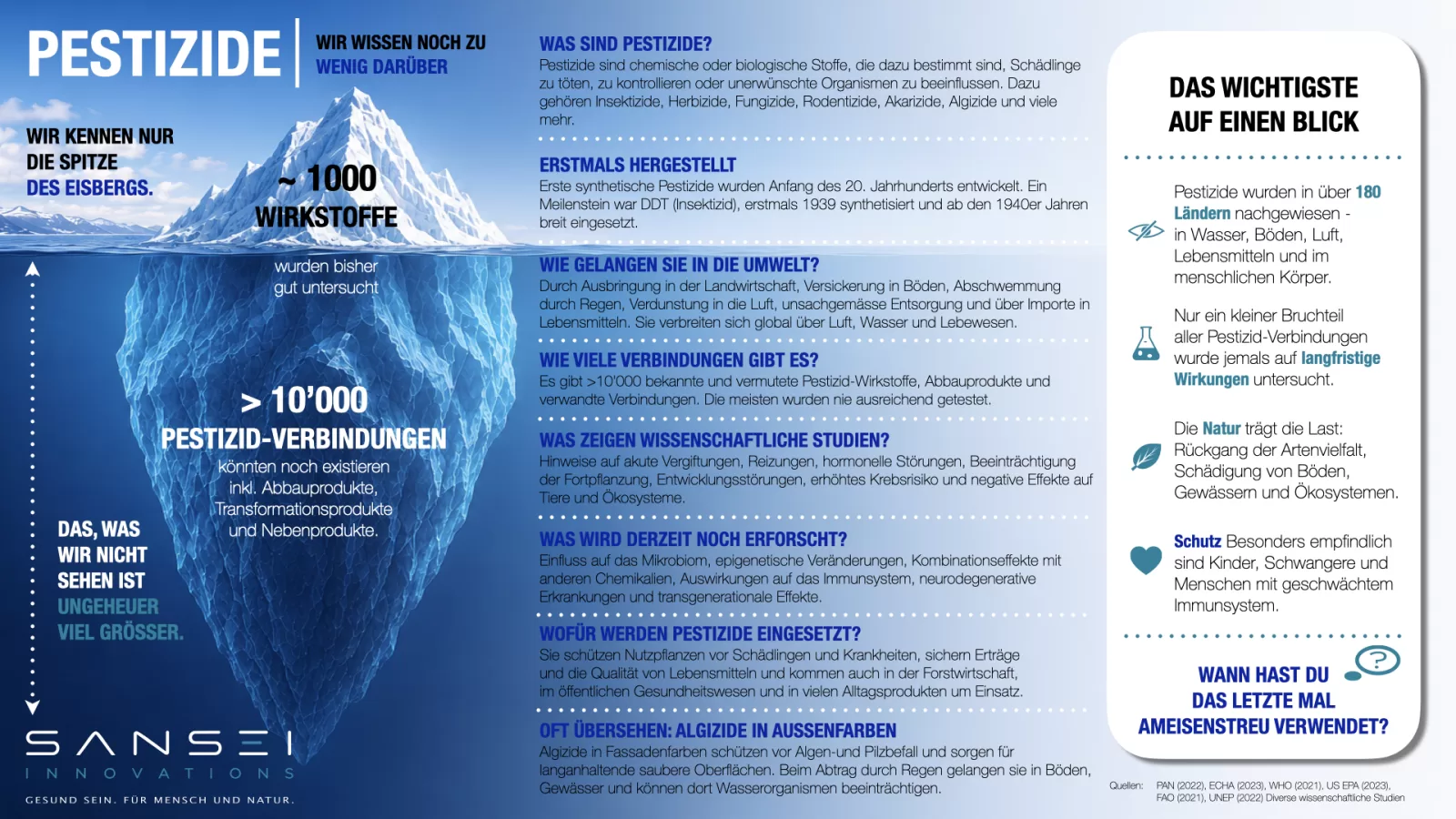
Pesticides are intended to control unwanted organisms or influence their development. They include plant protection products and certain biocides. Herbicides act against unwanted plants, fungicides against fungal diseases and insecticides against harmful insects.
After application, an active substance does not necessarily remain chemically unchanged. Biological and chemical processes in soil and water produce metabolites: breakdown products with properties of their own. Some are more mobile or persistent than the original compound and can reach groundwater more readily. The parent pesticide may have vanished from the market while its metabolites continue moving underground.
The routes from field to water
Whether a substance remains where it was applied depends on its chemical characteristics, the soil, weather, application method and local hydrology. Heavy rain can wash dissolved substances over the surface. Soil erosion may carry bound active substances into streams, rivers and lakes. More mobile compounds and metabolites can leach towards groundwater, while field drains may shorten the route considerably.
Not every incident begins across a wide area of farmland. A small mistake while filling or cleaning equipment in a farmyard can have a disproportionately large local effect if plant protection products enter a drain or drainage system.
Agroscope studies erosion, surface run-off, leaching, drainage discharge and farmyard drainage as key pathways into water. It also produces risk maps for around 22,000 small catchments, identifying where run-off, erosion, drains or point sources may be particularly important. (agroscope.admin.ch)
What Switzerland’s monitoring network finds
The National Groundwater Monitoring programme, NAQUA, tracks groundwater condition and long-term trends at more than 600 sites. According to the latest information from the Federal Office for the Environment, pesticides exceed 0.1 micrograms per litre at around 1 to 2 per cent of monitoring sites each year.
Metabolites are considerably more widespread. Across Switzerland, pesticide metabolites occur above 0.1 micrograms per litre at roughly one site in three. The intensively farmed Swiss Plateau is particularly affected. (bafu.admin.ch)
National averages say little about your own supply. Geology, soil, rainfall, land use, groundwater recharge and aquifer depth all influence which substances appear. For your drinking water, the decisive evidence comes from the relevant local water supplier.
What the 0.1 microgram limit means
In Switzerland, a maximum value of 0.1 micrograms per litre generally applies to relevant pesticide active substances and relevant metabolites. It is precautionary and intended to protect drinking-water resources over the long term. Groundwater used, or intended to be used, as drinking water must meet the requirements of food law after simple treatment. (bafu.admin.ch)
This maximum value is not an individual toxicological effect threshold for every substance. Exceeding it requires investigation, but does not by itself demonstrate a risk of acute poisoning. Precaution has a different purpose: to stop avoidable contamination before it develops into a health problem.
A specific risk assessment considers the type and concentration of the active substance or metabolite, the frequency and duration of intake, toxicological properties, possible combinations of substances and people with particular sensitivities. The Federal Food Safety and Veterinary Office therefore distinguishes between analytical detection, a precautionary maximum value and a health assessment. Authorised plant protection products undergo comprehensive assessment and, when used as directed, should not endanger consumers. (blv.admin.ch)
Streams face a different kind of exposure
Pesticides are designed to have biological effects. Away from their intended place of use, those effects may reach organisms they were never meant to target. Small watercourses in intensively farmed areas can be exposed to temporarily elevated concentrations after rainfall.
A concentration assessed one way for human drinking water may already matter to aquatic organisms. Protecting water therefore preserves both a future drinking-water resource and the communities of plants and animals living in streams and rivers.
Prevention starts at the source
Water treatment can reduce contamination, but the more sustainable — and usually more effective — approach is to prevent problematic substances from reaching soil and water. Farming suited to local conditions, precise application, adequate buffer distances and appropriate mechanical, biological or other non-chemical methods can reduce risk at source.
Where plant protection products are needed, the details matter. Weather and soil conditions must be suitable, and appropriate techniques should limit spray drift and run-off. Equipment must not be filled or cleaned near drains or watercourses. Residues and packaging require proper disposal, and every product must be used strictly in accordance with its authorisation.
More precise application technology, forecasting models, resistant varieties, mechanical methods, biological strategies and digital systems can make treatment more targeted. The relevant measure is not simply how much product is applied, but the risk it poses to people, soil, water and ecosystems.
When contamination reaches an abstraction point
If contamination is detected, a water supplier may be able to switch to another abstraction point, blend water from different sources or add treatment. Options for organic micropollutants include activated carbon, oxidation processes and membrane technologies.
The right method depends on the substance, its concentration and the composition of the water. A process that reliably removes an active substance will not necessarily retain all its metabolites equally well. For dependable information about your local drinking-water quality, contact the responsible water supplier or the relevant cantonal authority.
Household filters need specific evidence
A claim that a household filter ‘removes pesticides’ is too vague to support a serious judgement. What matters is whether it reduces the particular active substance or metabolite present in your water under the stated operating conditions.
Look for before-and-after analyses, independent laboratory results and clear information about the filter medium, contact time, service life and maintenance. A meaningful performance claim must be demonstrated for the substance actually found in the water.
From a laboratory figure to a sound conclusion
Modern analytical methods can reveal metabolites that previously went undetected. Monitoring is becoming more informative even as plant protection practices continue to evolve.
Chlorothalonil captures the central challenge: stopping its use prevents new applications, but cannot instantly remove decades of residues from the ground. Effective protection therefore depends on prevention at source, long-term monitoring, scientific risk assessment and targeted treatment.
When a pesticide or metabolite is found in Swiss groundwater, the useful questions are precise: which substance was detected, how did it enter the water, how long is it likely to remain, and does it reach your supply? Those answers turn a measurement into a sound conclusion — and show where action can make the greatest difference.
Sources and further information
- Federal Office for the Environment — Groundwater quality — current Swiss data on pesticides and pesticide metabolites in groundwater.
- Federal Office for the Environment — Chlorothalonil in groundwater — information on metabolites, monitoring data and groundwater-quality requirements.
- Federal Food Safety and Veterinary Office — Plant protection product residues in food — information on risk assessment, maximum levels and chlorothalonil.
- Agroscope — Plant protection products entering water — research into erosion, surface run-off, leaching, drainage discharge and farmyard drainage.
- Agroscope — Plant protection products: effects, risks and research — Swiss research into environmental behaviour, risks and alternative crop-protection strategies.
