


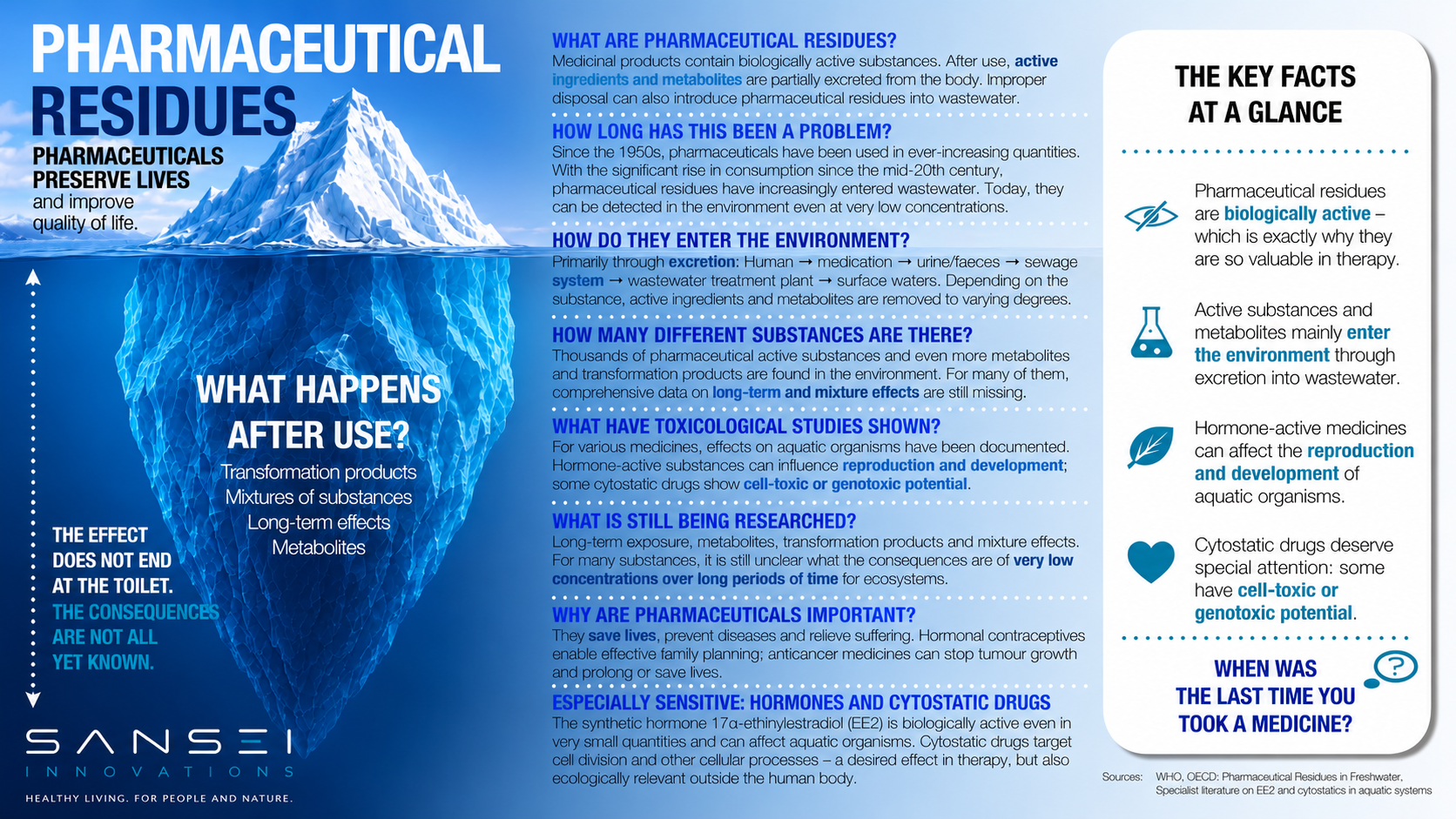
Medicine does its job in the body, but its journey does not necessarily end there. Active substances and their breakdown products leave the body, enter wastewater and may pass through treatment plants. Under certain conditions, they can then travel through streams and rivers into groundwater.
Switzerland’s Federal Office for the Environment (FOEN) detects pharmaceuticals and their metabolites at around 15 % of groundwater monitoring stations. Concentrations are generally below 0.1 micrograms per litre. Those figures deserve attention, but they do not automatically mean that the water you drink is unsafe.
The important distinction is between detection and risk. A substance may be measurable without posing a significant health threat. Its biological activity, concentration, duration of exposure, possible mixtures, and the origin and treatment of the water all matter. Protecting drinking water therefore calls for neither panic nor blanket reassurance, but for sound data, precaution and effective treatment.
The number on the lab report is only the beginning
Medicine residues include active pharmaceutical ingredients, their metabolites and other transformation products. They may come from painkillers, antibiotics, blood-pressure medicines, anti-epileptic medicines, hormone-active substances, X-ray contrast media and medicines used in cancer treatment.
Modern analytical methods can detect such substances at nano- or low-microgram concentrations per litre. That sensitivity is valuable for monitoring, but it does not change what a result means: “detected” simply means that a substance is present. Whether it represents a health risk depends on its effects and on the exposure people actually receive.
From the bathroom to the aquifer
The most common route starts with normal use. Active substances and metabolic products leave the body in urine and faeces, then travel with wastewater to a wastewater treatment plant. Conventional treatment removes many contaminants reliably, but it is not designed to retain every micropollutant in full.
Some substances therefore leave the plant with treated effluent and enter surface waters. Where groundwater is connected to a river, that water may infiltrate into the ground. FOEN finds residues particularly often in unconsolidated-aquifer groundwater influenced by rivers carrying treated wastewater.
A simple household measure
Do not flush unwanted tablets or pour liquid medicines down the sink. That sends concentrated residues straight into the wastewater system. Return medicines you no longer need to a suitable collection point. Depending on the canton and municipality, pharmacies, chemists or local collection facilities may accept them.
Other sources are more concentrated
Hospitals and other medical facilities can contribute locally significant quantities. Pharmaceutical manufacturing may produce considerably higher concentrations in particular areas. Veterinary medicines also reach soil, surface water and groundwater through excretion, manure and run-off. The OECD identifies pharmaceutical manufacturing sites, intensive agriculture and aquaculture, alongside municipal wastewater, as possible sources of contamination.
What the Swiss monitoring data show
FOEN’s 2024 data do not suggest that groundwater is affected evenly across Switzerland. Detections occur mainly at monitoring stations close to rivers. Among the substances most frequently found are the anti-epileptic medicine lamotrigine, the antibiotic sulfamethoxazole and the X-ray contrast medium amidotrizoic acid.
Groundwater, however, is not the same thing as drinking water. Before it reaches your tap, water may pass through an abstraction system, be blended with water from other sources and receive additional treatment. A result from a groundwater station therefore does not automatically describe the water you drink at home.
What can be said about health risk?
The World Health Organization considers the trace concentrations reported so far in drinking water very unlikely to pose a significant risk to the general population. That is not a blanket all-clear for every substance or every circumstance. Important uncertainties remain, particularly around lifelong exposure to very low concentrations, possible breakdown products and mixtures of substances.
A responsible assessment has to bring several questions together. What does the substance do biologically? At what concentration is it present? How long does exposure last? Which transformation products are formed? Are several active substances present at once? And could certain groups be more sensitive than the general population?
Detection is not automatically a health hazard. Equally, a low concentration alone does not justify blanket reassurance if a substance is especially potent or its long-term effects are not yet well understood.
For aquatic life, tiny amounts can still matter
Human health is not the only consideration. Medicines are designed to alter biological processes precisely. If they enter water continuously, even very low concentrations may affect sensitive organisms. Hormone-active substances, for example, can interfere with reproduction, while some psychoactive substances can alter the behaviour of aquatic animals.
Antibiotic residues add another concern. Their presence in the environment is associated with the development and spread of antimicrobial resistance. Protecting water ecosystems therefore safeguards not only habitats, but also an important foundation of future healthcare.
Why cytotoxic medicines call for extra care
Cytotoxic medicines, used particularly in cancer treatment, deserve special attention. Some work by inhibiting cell division or interfering with genetic material. Effects that are carefully controlled in medicine may have unwanted biological consequences outside treatment.
The OECD notes that, for certain cytotoxic substances with direct effects on DNA, it may not be possible to assume a clearly safe lower threshold. At the same time, robust data are lacking on long-term exposure to minute quantities and on the effects of mixtures.
That does not mean that every trace of a cytotoxic medicine in water represents an immediate danger. It does mean that these substances require particularly consistent disposal practices, precaution and monitoring.
Treatment technology is improving, but prevention still matters
Switzerland is tackling micropollutants before they reach the tap. Selected wastewater treatment plants are being fitted with an additional treatment stage designed to remove pharmaceuticals, chemicals and cleaning products more effectively. Technologies include ozone and activated carbon.
In 2024, around 15 % of Switzerland’s population was connected to a plant with this additional treatment. If the expansion programme proceeds as planned, the figure should reach around 70 % by 2040. FOEN also points out that even then, not every water body will be completely free from pharmaceutical contamination. New treatment capacity matters, but it cannot do the whole job alone.
Your part in keeping medicines out of the water cycle
The most effective household measure is hardly dramatic: never dispose of medicines down the toilet or sink. Return them to a collection point and follow the instructions issued by your council or canton.
Using medicines as prescribed also matters. The fewer unnecessary active substances that enter the drain, the less technical effort is needed to remove them later. Preventing pollution at source is usually simpler and more effective than cleaning it up downstream.
What household filters can—and cannot—show
Whether a filter reduces medicine residues depends on the substance, its concentration, the filter medium, contact time and the treatment process as a whole. Activated carbon and oxidation processes can produce very different results for different compounds.
The claim “filters medicines” is therefore not enough to establish quality. Look for specific information about the substances tested, independent laboratory checks, transparent before-and-after measurements and clearly defined operating conditions. The meaningful figure is not the promise on the packaging, but the reduction measured under realistic conditions.
The questions researchers are still working through
As analytical methods become more sensitive, more active substances and transformation products can be detected. Research must therefore establish what decades of contact with minute concentrations may mean, how mixtures behave and whether breakdown products could be more problematic than the original medicine.
WHO and the OECD continue to identify gaps in knowledge about long-term exposure and combined effects. The sensible approach has two parts: prevent problematic substances from entering the environment wherever possible, and monitor and reduce unavoidable contamination in a targeted way.
The sensible response is precaution, not panic
Medicine residues in water are a real environmental and monitoring issue. Swiss measurements show detections in certain groundwater resources, particularly those close to rivers. That does not automatically mean that the water from your tap is unsafe.
The right response is neither alarmism nor indifference. Return unwanted medicines instead of flushing them, improve wastewater treatment, protect waterways and make monitoring data transparent. Those measures need to work together.
Drinking-water protection starts well before the tap. It starts wherever you can prevent unnecessary active substances from entering the water cycle in the first place.
Sources and further information
- Swiss Federal Office for the Environment (FOEN) – Pharmaceuticals in groundwater – Swiss monitoring data on occurrence, concentrations and frequently detected substances.
- Swiss Federal Office for the Environment (FOEN) – Municipal wastewater treatment – Information on expanding treatment stages for micropollutants.
- World Health Organization (WHO) – Pharmaceuticals in Drinking-water – Health assessment of pharmaceutical traces in drinking water and remaining knowledge gaps.
- OECD – Pharmaceutical Residues in Freshwater – Environmental effects, long-term exposure, mixtures and specific issues surrounding cytotoxic substances.
